In today’s construction environment, builders juggle tight timelines, cost pressures, and the need to keep multiple stakeholders aligned. When it comes to flooring systems, however, the balance between convenience and compliance can become blurred — particularly when decisions are influenced by what suits the sub-contracting company rather than what best serves the project.
The reality is, while it’s easy to agree with a company’s preferred system, the ultimate responsibility for a building’s long-term performance sits with the designer.
And that begins with the concrete specification.

Why AS 1884:2021 Exists — and Why It Matters
The Australian Standard AS 1884:2021 – Floor Coverings: Resilient Sheet and Tile – Installation practices outlines how subfloors must be prepared before resilient flooring is installed. Central to this standard is the requirement to ensure that moisture levels and vapour transmission from the concrete substrate are adequately controlled.
These aren’t arbitrary rules. They exist to safeguard the performance, safety, and longevity of the finished floor. If moisture vapour continues to move through a slab after installation, it can lead to delamination, adhesive failure, blistering, and mould growth. All of which are costly to rectify and detrimental to client health & satisfaction.


Clause 3.4.3.2 — Understanding Surface Treatments
AS 1884:2021 specifically states in Clause 3.4.3.2 that:
“Surface waterproofing additives, curing compounds and other types of treatments or coatings will adversely affect the adhesion of the floor preparation and resilient covering to subfloor and shall be removed by mechanical preparation methods.”
This clause exists to ensure that any surface film or residue left on a slab; from curing compounds, sealers, or coatings, does not interfere with the bond between the adhesive and the substrate.
It’s an important distinction. These restrictions apply to surface-applied materials that sit on top of the concrete, not to internal admixtures that work within it.
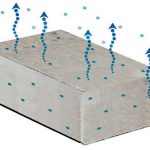
The Role of an MVRA (or WVRA) is to manage moisture from within
CLEVA CRETE 842 MVRA is a proactive internal moisture vapour reduction admixture, Its VOC free liquid design prevents moisture movement through the concrete matrix….not across the surface.
Because it is incorporated directly into the mix within the Concrete Agi truck just prior to pumping, 842 MVRA minimises the internal pore structure of the concrete to reduce permeability and permanently stabilise vapour transmission. It leaves no surface film or residue, meaning it remains fully compatible with flooring adhesives and preparation systems as required by AS 1884:2021.
By controlling moisture from within, builders can achieve compliance with the intent of the standard while eliminating the risks associated with surface-applied waterproofing compounds that must later be mechanically removed.
This approach ensures that moisture management is integrated into the structure itself, supporting both specification integrity and long-term durability.
Doing What’s Right — Not Just What’s Easy
Builders often face pressure to accept systems recommended by flooring contractors and their adhesive suppliers. Sometimes because they’re familiar, sometimes because they appear to simplify the process. But convenience should never override compliance.
AS 1884:2021 is clear about what’s required, and specifications exist for a reason: to build safer, longer-lasting structures and reduce the risk of costly call backs or remediation.
Choosing a high-performance admixture, manufactured in Australia, with Australian components, like CLEVA CRETE 842 MVRA isn’t about rejecting flooring systems; it’s about ensuring the substrate beneath them already meets the intent of the standard. It’s a proactive decision that protects everyone involved. The builder, the client, and the flooring team… by ensuring the concrete is compliant, consistent, and safe.
Building with Confidence
Leadership in building comes from being confident enough to have discussions, and question “how it’s always been done.” It’s about doing what’s right for the project, not just what’s easiest in the moment.
At the end of the day, meeting flooring standards doesn’t start at the surface, it starts with the concrete.
CLEVA CRETE 842 MVRA gives builders the confidence to get it right, every time.
Talk to us about our product and its specifications before making a decision that keeps someone happy who isn’t the client.
We invite you to dive a little deeper into concrete, and not just look at what happens on the surface.